

Reproduced with permission of the MOD
Subsequent Name: TV Tristram
Official Number: 334639
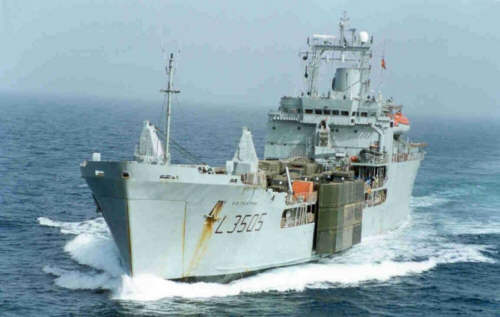
Class: SIR LANCELOT CLASS Landing Ship Logistics
Pennant No: L3505
Laid down: 14 March 1966
Builder: Hawthorne Leslie, Hebburn
Launched: 12 December 1966
Into Service: 1970
Out of service: 16 December 2005
Fate:
Items of historic interest involving this ship: -
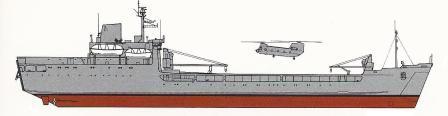
Background Data: In December 1961 the following announcement was made: War Office Military Supply Ship: “A 6000t ocean-going twin screw military supply vessel has been ordered by the MOT from the Fairfield Shipbuilding and Engineering Co Ltd at Govan, who are to develop the final specifications of the ship, which is expected to cost about £1million. Building will start around February 1962 and the ship is expected to be in service late in 1963 or early in 1964. The design calls for a fast troop and vehicle carrier capable of discharging onto beaches. She will have bow and stern loading facilities for tanks and military vehicles, ramp loading hatches, cargo handling cranes and provision for carrying and launching pontoons. A helicopter will be carried aft, and on completion she will have a Merchant Navy crew and will be managed by the British India Steam Navigation Co Ltd”. In March 1963 it was announced that tenders were to be invited for a further two vessels at a cost of £2 million each and all three would then replace thirteen former Tank Landing Ships and would be part of an eventual Class of five or six ships, all of which would be named after Knights of the Round Table. The final three vessels were ordered in April 1965, and in December 1968 it was announced that as from January 1970, the management of these six vessels, as well as that of one ex-LST, would be transferred to the RFA
February 1966 laid down as LSL 05
12 December 1966 launched by Hawthorn Leslie Shipbuilders Ltd, Hebburn as Yard Nr: 761 named SIR TRISTRAM for the Ministry of Transport
14 September 1967 completed and placed under management of British India Steam Navigation Co Ltd, London
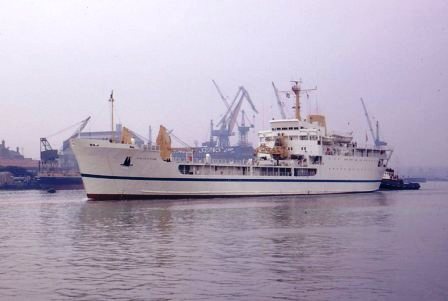
Sir Tristram before RFA service sails from the River Tyne
11 February 1969 the Aberdeen Evening Express reported -

19 January 1970 at Tobruk loading military stores, ammuntion, 43 vehicles and 76 passengers during the withdrawl of British Forces from Libya
21 January 1970 sailed Tobruk to the UK to discharge
30 January 1970 management transferred to the RFA
13 February 1970 at Tobruk loading military stores and 65 vehicles during the withdrawl of British Forces from Libya
15 February 1970 sailed Tobruk to Cyprus to discharge
21 February 1970 at Tobruk loading military stores and 43 vehicles during the withdrawl of British Forces from Libya
23 February 1970 sailed Tobruk to Malta to discharge
2 March 1970 at Tobruk loading military stores, 64 vehicles and 42 passengers during the withdrawl of British Forces from Libya
5 March 1970 sailed Tobruk to the UK to discharge
14 June 1970 Captain Barry H Rutterford RFA appointed as Master
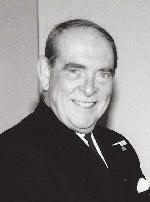
Captain Barry H Rutterford RFA
27 October 1970 arrived at Malta from Istanbul, Turkey
29 October 1970 sailed Malta for Marchwood Military Port
6 January 1971 at Singapore
25 January 1971 her Ship’s Badge was officially presented to her
26 January 1972 to 7 February 1972 along with HMS FEARLESS and RFA’s SIR BEDIVERE and SIR GERAINT she was part of the British Amphibious Task Force patrolling off British Honduras to provide an anti-invasion force
29 August 1973 stood by over a minature submarine unable to surface from a depth of 1,500 feet 150 miles SW of Cork while rescue submarines were flown to Cork City
30 August 1973 the Times newspaper reported -

8 September 1973 with HMS HECATE she stood by a dramatic three day rescue operation of men from the deep submergence submarine PISCES 111 off the Atlantic coast of Southern Ireland
5 April 1975 at Plymouth
12 June 1975 sailed from Malta
12 September 1975 in Grand Harbour, Malta with various RN ships and RFA's BACCHUS (3), LYNESS, OLNA (3) and SIR GALAHAD (1) after naval exercises
15 September 1975 sailed Grand Harbour, Malta for further naval exercises
28 October 1975 at Marchwood Military Port
24 June 1977 to 29 June 1977 took part in the Silver Jubilee Fleet Review at Spithead with eight other RFA's and units of the Royal Navy and foreign navies. Carried Official guests from Southampton Ocean Terminal along the lines of ship being reviewed by HM the Queen and returned them to Southampton Ocean Terminal
17 November 1979 berthed at Marchwood Military Port
7 February 1980 berthed at Marchwood Military Port
23 January 1980 berthed at Harwich
24 January 1980 sailed Harwich to Ulrik, Norway
26 January 1980 arrived at Ulrik, Norway for Army winter exercises - unloaded troops and equipment
27 January 1980 sailed Ulrik, Norway
29 January 1980 berthed at Marchwood Military port
13 February 1980 sailed for the Panama Canal
28 February 1980 transitted Panama Canal
12 March 1980 berthed alongside at Prince Rupert to unload dead tanks
14 March 1980 local school children given a conducted tour around the ship by junior officers
15 March 1980 sailed Prince Rupert
17 March 1980 alongside at Vancouver
23 March 1980 the ships officers played a local football team - the ship lost
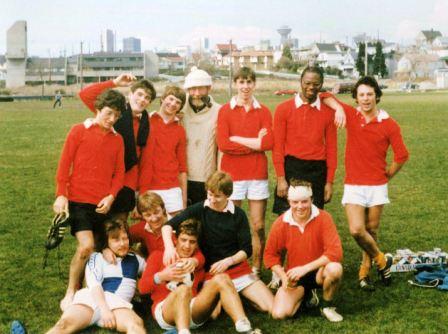
RFA Sir Tristram's 1980 Football Team
Back row from left to right -
J/RO Robin Hookham - unknown - unknown - Captain R W Wallace (?) - unknown - 1st RO Denver Ambersley - 2nd RO Bruce Davies
Front Row - all unkown
Help to identify the unknowns would be appreciated
24 March 1980 sailed. While on passage south the ship received a signal to divert to Long Beach, CA to pick up 2 Buccaneer aircraft for onward transportation to the UK
28 March 1980 alongside Long Beach, California container berth
2 April 1980 loaded 2 Buccaneer aircraft
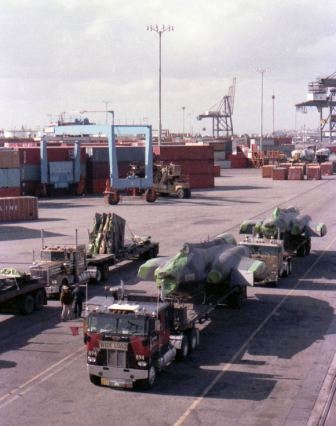
Two Buccaneer aircraft awaiting to be loaded onto RFA Sir Tristram
3 April 1980 sailed to Panama City arriving 12 April 1980 and berthed alongside
14 April 1980 transitted Panama Canal northbound
29 April 1980 berthed at Hull to unload aircraft
30 April 1980 sailed from Hull
1 May 1980 berthed alongside at Marchwood Military Port
6 October 1980 berthed alongside at Marchwood Military Port
31 December 1981 at Marchwood Military Port
10 June 1981 2nd Officer Roger B Thomas discharged dead
2 April 1982 was diverted from Belize to Ascension Island to join the Amphibious Landing Group for Operation Corporate - the Falklands Conflict
29 April 1982 sailed Ascension Island in company with RFA’s SIR GALAHAD (1), SIR GERAINT, SIR LANCELOT, SIR PERCIVALE and PLUMLEAF (2) and HM ships FEARLESS, INTREPID and ANTELOPE
8 May 1982 entered the TEZ (Total Exclusion Zone) around the Falkland Islands
21 May 1982 entered San Carlos Water with the Amphibious Landing Force
6 June 1982 sailed San Carlos for Fitzroy Creek
7 June 1982 anchored Fitzroy Creek and commenced discharge
8 June 1982 was bombed and extensively damaged by Argentinian Skyhawk aircraft at Port Pleasant, Fitzroy Creek just south of Bluff Cove. She was hit by three bombs - one bomb entered 25 tank starboard and passed through without detonating. One bomb passed across the tank deck entered 25 tank Port where partial detonation occured blowing out, a large plate on the port quarter and causing damage to the forward bulkhead. The third bomb exploded under 25 and 26 tanks rupturing the ships hull. It is believed this bomb also contributed to the combined effects of the other two bombs. Fires soon started in the steering flat above which were pallets of ammunition and the ship was abandoned. She sent her lifeboats to assist in the evacuation of her sister ship RFA SIR GALAHAD nearby. Her crew were evacuated to the LPD’s HMS FEARLESS and HMS INTREPID. She eventually grounded on her stern door and was afterwards towed off by her sister ship RFA SIR GERAINT. She was taken around to Port Stanley to be used as an accommodation hulk while a decision was made about her future
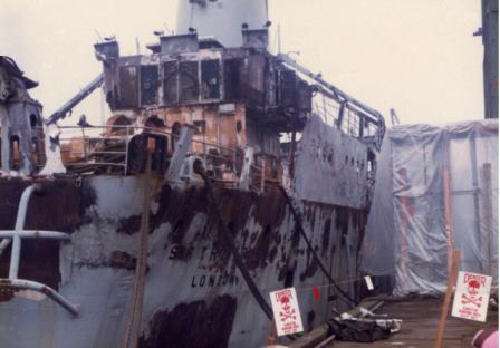
11 June 1982 her crew together with the survivors from RFA SIR GALAHAD (1) were transferred to STUFT ATLANTIC CAUSEWAY for onward movement to the STUFT BP tanker BRITISH TRENT which transported them to Ascension Island arriving on 23 June 1982 from where they were flown back to RAF Brize Norton in the U.K
16 May 1983 left Port Stanley aboard the Danish heavy-lift semi-submersible DAN LIFTER for the U.K. for rebuilding
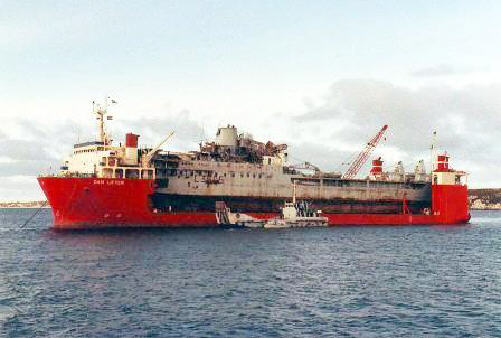
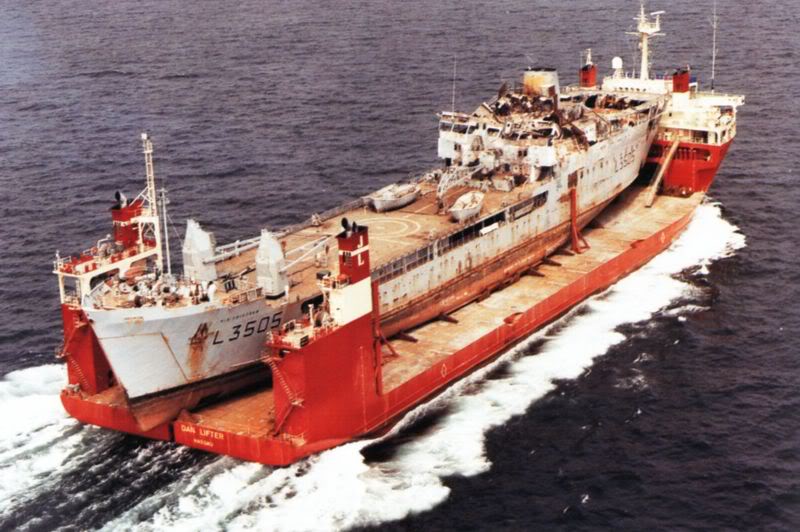
13 June 1983 arrived Teeside and was refloated
14 June 1983 was towed to the Tyne for inspection
10 August 1984 the contract to rebuild and lengthen her was awarded to Tyne Shiprepairers Ltd., Wallsend and she entered drydock for a 14 month rebuilding programme
2 October 1985 was awarded her Falkland Islands 1982 Battle Honour at Newcastle by Mr A Kemp DGST (N)
9 October 1985 rebuilding completed and she re-entered service. Dimensions now 442’05”(o.a.) x 58’ 10” x 13’00”. Tonnages now 4775 grt 1930 nrt 2443 dwt.
14 October 1985 visited the Pool of London after rebuild and berthed alongside HMS BELFAST. Captain (X) Robin Green DSC RFA was her Commanding Officer
16 October 1985 while berthed on HMS BELFAST was open to the public for two hours
25 October 1985 Captain (X) Peter J Lannin RFA appointed as Master
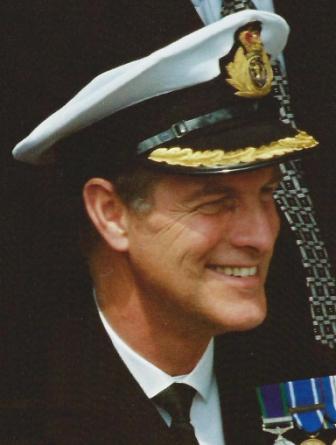
Captain Peter J Lannin RFA
11 April 1986 at Marchwood Military Port
4 August 1986 at Portsmouth
17 August 1986 at Marchwood Military Port
April 1988 together with RFA SIR PERCIVALE involved in Exercise Dragon Hammer in the Mediterranean
31 August 1988 until 21 September 1988 together with all the other LSL's with the exception of RFA SIR LANCELOT was involved in Exercise Teamwork 88
14 October 1988 at Marchwood and Captain Pat Thompson RFA appointed as Master
4 November 1988 Captain Anthony Pitt DSC RFA appointed in command while also Marine Superintendent RFA HQ at Empress State Building
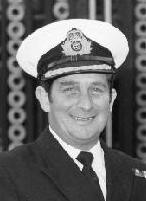
Captain A F Pitt DSC RFA
22 August 1989 Captain Peter Robinson RFA appointed as Commanding Officer

Captain Peter Robinson RFA
6 September 1990 her deployment, and that of RFA SIR GALAHAD (2), to the Gulf area was authorised following the Iraqi invasion of Kuwait
28 September 1990 sailed from Marchwood Military Port for the Persian Gulf
26 November 1990 Captain Brian J Waters RFA appointed as Commanding Officer
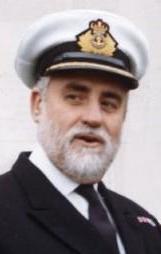
Captain Brian J Waters RFA
28 September 1990 sailed Marchwood Military Port for service during Operation Granby - the Gulf War - carrying armoured repair and recovery vehicles as well as machinery and supplies for the 7th Armoured Brigade
9 December 1990 sailed Marchwood Military Port bound for Al Jubayl
26 December 1990 suffered heavy weather damage but continued on passage to the Gulf Area
April 1991 arrived home from the Persian Gulf
1991 was awarded the Kuwait 1991 Battle Honour along with ten other RFA‘s
28 July 1991 at Portland
24 March 1992 together with RFA SIR BEDIVERE assisted in returning Royal Marines from Exercises in Norway
17 April 1992 at Portland
24 June 1992 Captain Shane Redmond OBE RFA appointed as Commanding Officer
29 September 1992 Captain Peter Robinson RFA appointed as Commanding Officer
4 January 1993 arrived at and sailed same day from Devonport
16 January 1993 arrived at Devonport
17 January 1993 sailed from Devonport but returned the same day after a fire
19 January 1993 sailed Devonport after repairs
7 April 1993 sailed from Devonport to carry out a compass swing
16 April 1993 arrived at Devonport
23 April 1993 arrived at Devonport
4 May 1993 sailed Devonport together with RFA's SIR BEDIVERE and SIR GERAINT
16 June 1993 arrived at Devonport
4 September 1993 together with RFA SIR BEDIVERE arrived Devonport and sailed the
following day
3 December 1993 berthed at Marchwood Military Port
8 December 1993 sailed from Marchwood Military Port
30 March 1994 berthed at Marchwood Military Port
21 April 1994 sailed from Marchwood Military Port
25 April 1994 arrived at Devonport
April/May 1994 involved in Exercise Dynamic Impact 94 with RFA's SIR GERAINT and RFA SIR GALAHAD (2)
25 May 1994 arrived at Devonport
9 June 1994 berthed at Marchwood Military Port
26 July 1994 berthed at Marchwood Military Port
4 August 1994 sailed from Marchwood Military Port
21 September 1994 berthed at Marchwood Military Port
3 October 1994 sailed Marchwood Military Port
19 October 1994 arrived Devonport
4 November 1994 sailed Devonport
7 Novemner 1994 at Middlesborough
6 February 1995 arrived at Devonport
2 March 1995 on the DG range at Devonport then sailed to sea
26 March 1995 arrived Marchwood Military Port
31 March 1995 sailed from Marchwood Military Port
21 April 1995 arrived and sailed from Devonport
May 1995 in Exercise Destined Glory 95
18 May 1995 arrived at Marchwood Military Port
22 May 1995 Marchwood Military Port
June 1995 in JMC 952
1 July 1995 at Marchwood Military Port
24 July 1995 arrived at Marchwood Military Port
4 August 1995 sailed from Marchwood Military Port
4 September 1995 berthed at Millbay Docks, Plymouth
5 September 1995 sailed from Millbay Docks, Plymouth
15 September 1995 arrived Devonport
21 September 1995 berthed at Marchwood Military Port
9 March 1996 Captain Anthony F Pitt DSC RFA appointed as Commanding Officer
8 June 1996 at Trinidad
25 July 1996 berthed at Marchwood Military Port
November 1996 Captain James Murchie RFA was in command
13 May 1997 on the River Tees
27 August 1997 at Campeltown
18 September 1997 at Portsmouth
11 May 1998 berthed at Marchwood Military Port
12 June 1998 at Loch Ewe
13 July 1998 berthed at Marchwood Military Port
17 December 1998 Humanitarian relief - arrived Marchwood Military Port following a West Indies Deployment which included Operation Tellar - relief operations off the coasts of Honduras and Nicaragua following destruction and floods caused by Hurricane Mitch. She shared the Wilkinson Sword of Peace award with RFA BLACK ROVER for their outstanding contribution to humanitarian aid engaged with RN units in Operation Caribbean Fury off the coast of Honduran-Nicaraguan border. An estimated that 20,000 were feared to have died. More than 400 Royal Marines prepared to search for up to 900 people, including many children, stranded on the roofs of flooded villages along the Honduran-Nicaraguan border for the past ten days without food or water
21 November 1999 commenced FOST Training
27 March 2000 sailed Devonport on Aurora 2000 together with RFA SIR BEDIVERE and RFA FORT AUSTIN
May 2000 to April 2003 provided alongside support to British forces in Sierra Leone in Operation Palliser along with RFA’s SIR GERAINT and SIR PERCIVALE at different times. She arrived at Freetown in 04/01
25 June 2000 returned to Devonport on completion of Operation Palliser duties
26 June 2000 at Plymouth and Captain (X) Paul Whyte RFA appointed as Commanding Officer

Captain (X) Paul Whyte RFA
30 July 2000 at Marchwood Military Port
20 September 2000 entered the Pool of London under Tower Bridge to berth on HMS BELFAST and to host the Royal Logistic Corps' Millennium Celebrations. The RLC had various functional stands around the ship representing their various disciplines.

12 November 2000 part of the Amphibious Ready Group led by the assault ship HMS OCEAN which arrived off the coast of Sierra Leone on Operation Silkman - a high visibility demonstration of the U.K. commitment to Sierra Leone
15 December 2000 at Portsmouth
28 December 2000 at Marchwood Military Port
24 January 2001 Captain (E) Edward M Quigley RFA appointed as Chief Engineer Officer
13 March 2001 deployment to Norway with HMS INVINCIBLE for exercises within the Artic Circle stopped by the Norweigan Goverment due to an outbreak of foot and mouth among catlle and sheep in the West Country and the fear that the troops being carried on both ships might be carriers (details from the Falmouth Packet of this day)
27 March 2001 Captain Shaun Jones RFA appointed as Commanding Officer
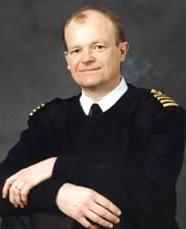
Captain Shaun Jones RFA
7 April 2001 berthed at Las Palmas
May 2001 at Freetown, Sierra Leone
14 August 2001 at Devonport
18 August 2001 Captain G Jarvis RFA appointed as Commanding Officer
September 2001 engaged on the Argonaut 2001 deployment together with HMS ILLUSTRIOUS, fourteen other Royal Naval Warships and RFA's FORT VICTORIA, BAYLEAF (3), SIR BEDIVERE, SIR PERCIVALE, SIR GALAHAD (2), FORT ROSALIE (2), FORT AUSTIN, OAKLEAF (2) and DILIGENCE
25 December 2001 enaged in Operation Veritas in the Middle East
28 March 2002 at Salalah and Captain Trevor J Iles RFA appointed as Commanding Officer

Captain Trevor J Iles RFA
11 July 2002 at Dubai
15 August 2002 on Netley Buoys, Southampton Water
3 September 2002 to 6 September 2002 berthed at Cartagena with RFA's FORT AUSTIN and SIR GALAHAD (2)
10 September 2002 berthed alongside at Portsmouth dockyard
15 January 2003 deployed for service during Operation Telic - the 2nd Gulf War - along with 13 other RFA’s
12 July 2003 berthed at Grand Harbour, Malta with HMS's GRIMSBY, RAMSEY, SHOREHAM and LEDBURY
4 August 2003 returned to Portsmouth on completion of Operation Telic duties
24 June 2003 Humanitarian aid - rescued 27 crewmen from the Egyptian bulk carrier GREEN GLORY on passage from Bombay to Leixoes in Portugal which sank in the Indian Ocean approximately 240 miles off the coast of Oman.and landed them at Djibouti. The survivors were airlifted to her by the Knightrider helicopter from USNS CONCORD also in the area
29 September 2003 at Portsmouth and Captain Trevor J Iles RFA appointed as Commanding Officer
5 January 2004 at Portland
12 March 2004 suffered an engine room fire during the annual Royal Marines exercises in northern Norway. The Royal Marines were evacuated to her nearby sister ship RFA SIR PERCIVALE. No injuries reported
13 March 2004 docked Harstad for damage assessment and repairs
28 June 2004 at Mayport
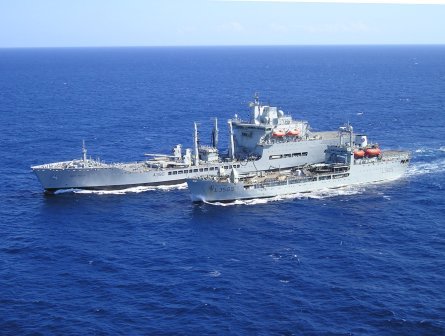
26 October 2004 RASed with RFA WAVE RULER (2)
30 November 2004 Captain (E) Graham Turner RFA appointed as Chief Engineer Officer
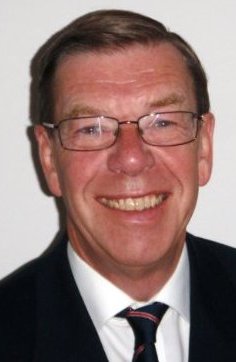
Captain (E) Graham Turner RFA
8 February 2005 Captain Peter Farmer RFA appointed as Commanding Officer
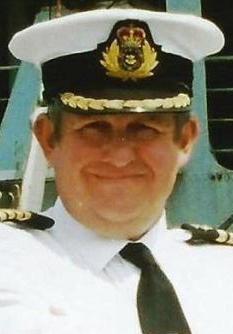
Captain Peter Farmer RFA
23 March 2005 Captain Peter Farmer RFA appointed as Commanding Officer
28 June 2005 took part in the International Fleet Review for Trafalgar 200 at Spithead along with RFA’s ARGUS, FORT GEORGE, FORT VICTORIA, ORANGELEAF (3), SIR BEDIVERE, SIR GALAHAD (2) and WAVE RULER (2)
7 July 2005 entered dry dock at Inchgreen, Greenock for repairs
22 August 2005 Captain (E) Robert Settle RFA appointed as Chief Engineer Officer
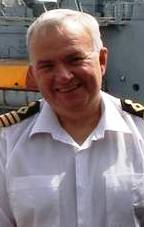
Captain (E) Robert Settle RFA
7 September 2005 sailed Liverpool after refit
16 December 2005 final voyage from Marchwood Military Port to Portsmouth to lay up. At Portsmouth to destore prior to disposal. Announced this day she was to be converted into a Training Ship for Special Maritime Forces to replace RAME HEAD
March 2006 removed from the Operational List
1 May 2007 sailed Portsmouth in tow of the Spanish-registered tug RED WOLF
2 May 2007 arrived Falmouth Ship Repairers for conversion for her new role as Training Ship for Maritime Special Forces to replace the former escort maintenance ship RAME HEAD, which was moved from her moorings in Portsmouth Harbour to the Dockyard on 23/05/07 so that the Mooring and Salvage Vessel SALMAID could start work on the moorings for the return of SIR TRISTRAM in her new role. The work undertaken to prepare her for her new role included
- Accommodation strip out and removal of asbestos
- CCTV installation for range safety reasons
- Sanitisation of ships systems
- Installation of new power supplied
- Installation of class rooms and viewing galleries
- Ballistic protection
- Water tight integrity ensured for a static role
- Long life anti fouling systems to obviate the necessity for docking over a 15 year period
- Upgraded ventilation system for smoke and fume extraction
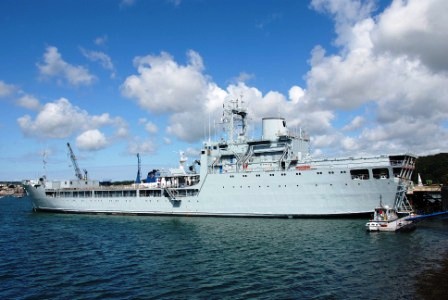
9 June 2007 moorings’ work completed and SALMAID sailed for Devonport
25 June 2007 left No 3 Dry-Dock at Falmouth and berthed on Queens Wharf
22 August 2007 sailed Falmouth under the tow of the Spanish tug Red Wolf for Portland
23 August 2007 arrived Portland at start of her new career
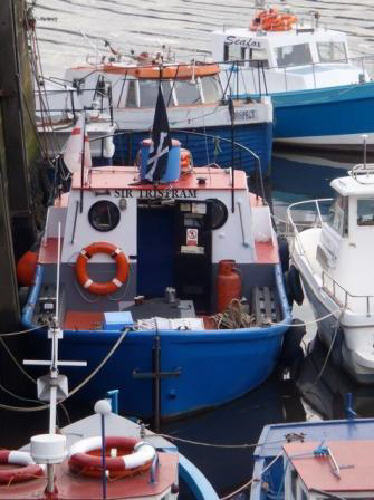
Her name and lifeboat live on - seen at Ouseburn on the River Tyne
© Mark Nugent – RFAHS member
2008 renamed TV Tristram
March 2013 was berthed at Queen's Pier, Portaldn for a refit lasting 6 weeks returning to her moorings in April 2013
24 October 2016 sailed from Portland under tow to Middlesborough for refit
12 December 2016 returned to Portland after her refit and continued in her training role
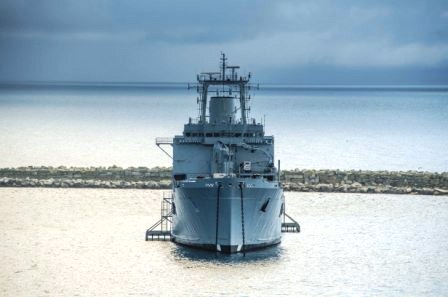
TV Tristram at her mooring at Portland Harbour

Notes:
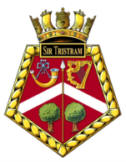
Was named after one of the 35 Knights of the Round Table in Arthurian legend who was the nephew of King Mark of Cornwall.